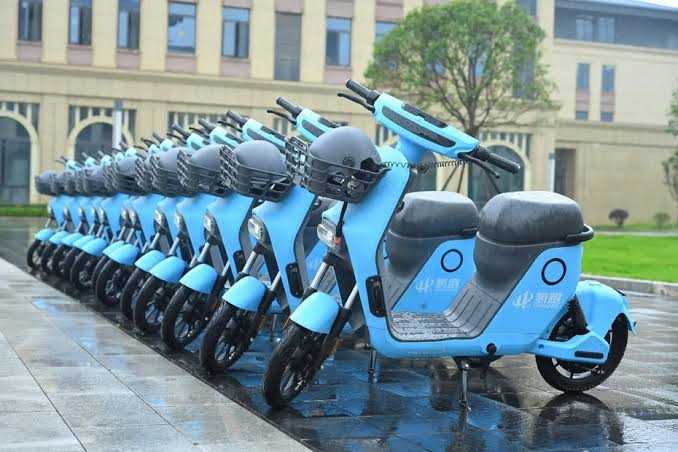
China’s city-wide fleet of shared hydrogen e-bikes
In Chengdu, capital of China’s Sichuan Province, a company called Qinglv Technology has launched a shared scooter service nicknamed the “hydrogen pony.” Since its launch in August 2024, the service has already facilitated over 3.5 million rides.
This development is a significant shift in urban mobility — from initial prototypes to the large-scale commercial application seen with the “hydrogen pony” in Chengdu. The shift toward solid-state hydrogen is a key enabling factor, allowing these scooters to address the strict fire safety regulations that have limited lithium-ion fleets in Chinese cities.
These scooters aren’t sold to regular buyers for home use—they operate strictly as public share fleets (unlocked via a smartphone app).
Most of the time, you don’t even have to swap the fuel bottle yourself! Central maintenance crews monitor hydrogen levels in real time and swap depleted canisters on city streets. If you do run low mid-ride, you simply stop at an automated kiosk or drop off the vehicle in a designated parking zone.
How the tech works:
- Fuel Source: These e-bikes carry small green canisters loaded with hydrogen gas.
- The Engine: An onboard fuel cell mixes hydrogen with atmospheric oxygen to generate electricity on the spot, powering the electric motor.
- Exhaust “Emissions”: The only by-product is pure water vapor (H2O).

Why is this tech limited to lightweight two-wheelers?
It comes down to weight. Storing hydrogen safely at ultra-low pressure requires heavy “metal hydride” powders inside the canister. A single 100-gram cylinder gives a scooter about 100 km (~62 miles) of range, but scaling this exact solid-state tech to full-sized consumer cars would make the fuel tanks far too heavy and bulky.
Is it safe?
Unlike high-pressure industrial gas tanks, this solid-state technology keeps hydrogen chemically bound at low pressure. Field reports and operational data from Chinese municipal fleets show zero reported explosions or thermal runaway fires. Even if punctured, the gas bleeds out far too slowly to cause a sudden blast.
Sources:
Tea Gress, Aug 31, 2026. (Watch video reel at link): https://www.facebook.com/reel/1443394407933736
H2Rijders, Apr 18, 2026. https://h2rijders.nl/en/nieuws/35-miljoen-ritten-op-waterstof-hoe-de-chinese-waterstofpony-zijn-markt-vond-door-brand
