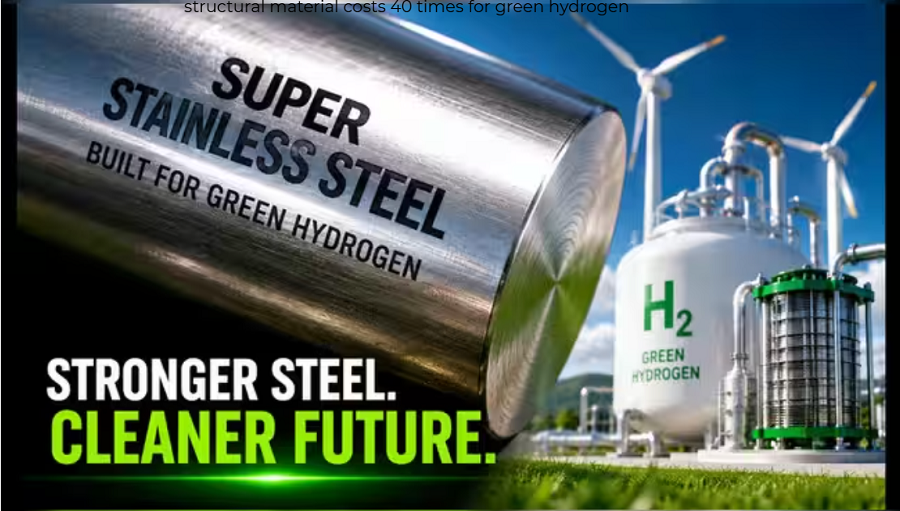
Scientists at China’s University of Hong Kong have developed a new corrosion-resistant stainless steel ( SS-H₂, “stainless steel for hydrogen“) that could replace expensive titanium components in green hydrogen production. Experts say the breakthrough has the potential to slash structural material costs by roughly 40 times and make seawater-based hydrogen production far more economical.
Green hydrogen is an environmentally clean fuel, but until now the process needed to produce it has been extremely expensive. The new SS-H₂ material can withstand the intense electrochemical conditions that cause ordinary stainless steel to fail, including the highly corrosive environment created during water electrolysis. The properties of SS-H₂ could allow use of cheaper steel to replace expensive titanium components currently used in hydrogen electrolyzers.
Why Green Hydrogen needs better materials
Green hydrogen is produced by using electricity to split water into hydrogen and oxygen. When renewable electricity from sources such as solar or wind supplies the electrolyzer, the resulting hydrogen can be produced without the direct carbon emissions associated with conventional hydrogen made from fossil fuels.
The chemistry sounds simple, but the equipment faces a difficult environment. An electrolyzer has to carry electrical current while exposed to reactive chemicals, high potentials and, in some systems, chloride-rich water. Seawater makes the problem harder because dissolved salts can attack metals and trigger localized corrosion. Chloride ions are particularly troublesome because they can penetrate protective surface films and initiate pits.
That creates an awkward economic trade-off. Materials used inside demanding electrolyzers must survive for long periods, yet the most corrosion-resistant options can be expensive. Titanium, sometimes combined with coatings involving precious metals, is used in applications where ordinary steel cannot survive the electrochemical conditions. For hydrogen producers, the material surrounding the chemistry can therefore become a major part of the cost.
The HKU team led by Professor Mingxin Huang approached the problem from a different direction. Instead of accepting the limits of conventional stainless steel and adding another coating, the researchers redesigned the alloy so its surface could protect itself across a much wider electrochemical range. The process developed by the scientists did not merely make the existing shield stronger. It created a second shield that appears when the first one approaches its limit.
At low electrochemical potential, chromium does the job. At higher potential, manganese becomes part of the defence. The two mechanisms operate sequentially rather than forcing one passive layer to survive indefinitely. That concept could potentially guide the development of other alloys designed for high-potential environments, including electrochemical technologies beyond hydrogen production.
This significant breakthrough could become part of a cheaper path toward producing clean fuel from water.
The research was reported in Materials Today.
Sources:
Intelligent Living, Aug 22, 2026. https://www.intelligentliving.co/new-super-steel-could-cut-green-hydrogen/
The Economic Times, Aug 17, 2026. https://economictimes.indiatimes.com/news/international/us/after-nearly-6-years-of-research-hku-scientists-created-steel-that-survives-1700-mv-in-seawater-potentially-replacing-titanium-parts-and-cutting-structural-material-costs-40-times-for-green-hydrogen/articleshow/133296704.cms
** Article posted on CEN website: https://china-environment-news.net/2026/08/23/chinas-new-steel-tech-could-slash-cost-of-making-green-hydrogen/
