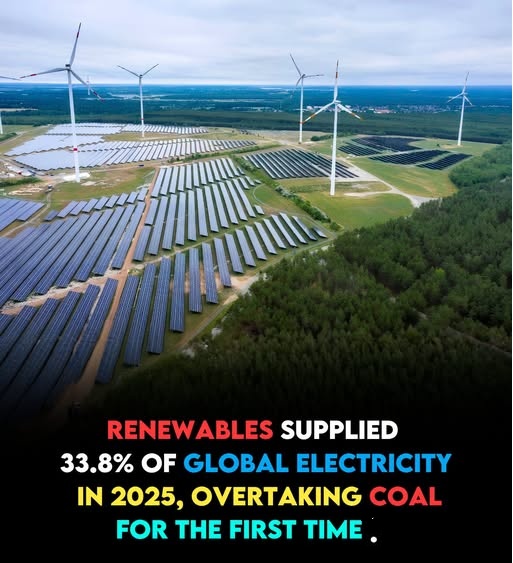
The world has crossed a major energy milestone, with renewable solar and wind reshaping how electricity is produced. China is leading by example not only by reshaping its own power mix but also playing a central role in the global transition to clean energy.
In 2025, global annual renewable capacity additions increased by 16% despite challenges linked to supply chain strains, grid connection delays, financial pressures and policy shifts. This marked the 23rd consecutive year that renewables set new expansion records. Solar PV accounted for more than 75% of new renewable capacity additions worldwide, followed by wind (20%). The remaining share was made up by hydropower, bioenergy, geothermal, concentrating solar power and marine energy.
According to data published in the Energy Institute’s latest Statistical Review of World Energy (2026), renewable sources supplied 33.8% of global electricity in 2025, surpassing coal’s 33% share for the first time. Solar generation alone increased by a record 636 terawatt-hours, meeting around 75% of the growth in global electricity demand.
The data shows that China accounts for roughly half of global installed wind and solar capacity as of 2025, with 641 gigawatts of wind and more than 1,200 gigawatts of solar power. No other country comes close, with the United States a distant second in both categories.

This dominance is the result of years of focused expansion. China has been adding renewable capacity at a pace unmatched anywhere else, driven by strong policy support, large-scale investment and the need to meet rapidly growing electricity demand. In 2025 alone, China installed 120 gigawatts of wind power capacity – more than the total installed capacity of any country except the United States. The gap is even more striking in solar power, where China added 315 gigawatts to the grid last year, which is equivalent to roughly one and a half times the United States’ entire installed solar capacity.
Beyond direct climate considerations, China’s rapid renewables buildout also reflects strategic priorities such as energy security and industrial policy. By scaling up wind and solar energy, the country reduces its dependence on imported fossil fuels while strengthening its global leadership in key technologies like solar panels, wind turbines and battery storage systems. As a result, China is not only reshaping its own power mix but also playing a central role in the global transition to clean energy.
China’s expansion in renewable capacity continued to increase in 2025, accounting for over 60% of global renewables growth. Last year, China alone commissioned nearly 370 GW of solar PV and 117 GW of wind capacity – 13% and 48% higher, respectively, than in 2024.
However, the transition is far from complete. Electricity demand continues to rise, while fossil fuels still generate most of the world’s power. Expanding renewable energy, battery storage and electricity grids will be essential to building a cleaner, more reliable future.
Sources:
Statista, July 2, 2026. https://www.statista.com/…/global-installed-wind-and…/
Energy Institute, June 30, 2026. https://www.energyinst.org/statistical-review
International Energy Agency, April 20, 2026. https://www.iea.org/reports/global-energy-review-2026/technology-solar-pv-and-wind
