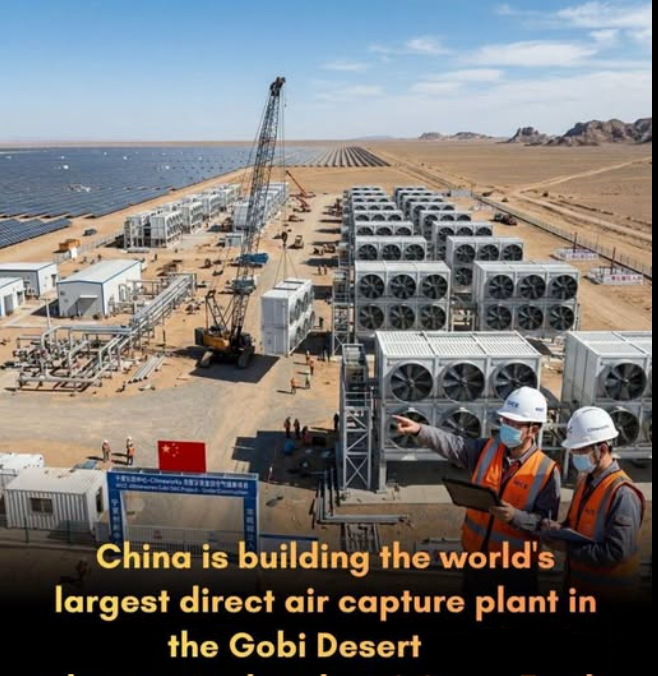
The project will use abundant cheap solar electricity to remove CO₂ direct from the atmosphere at scale.
China’s carbon neutrality by 2060 commitment cannot be achieved through emissions reduction alone. Aviation, agriculture, cement, and steel all produce CO₂ that cannot be fully eliminated through electrification or fuel switching within the 2060 timeframe. Carbon removal — pulling CO₂ from the atmosphere to offset these residual emissions — must therefore be part of China’s net-zero pathway.
The Gobi Desert offers near-ideal conditions for direct air capture. Solar irradiation is exceptionally high — some of China’s cheapest solar electricity is generated in the Gobi. The dry air reduces water vapor competition for CO₂ capture. And the geological formations beneath the Gobi’s deep sedimentary basins offer extensive carbon storage capacity.
Beijing Low Carbon Clean Energy Research Institute — NICE — and Swiss DAC technology company Climeworks have partnered for a 50,000-tonne-per-year DAC facility in Inner Mongolia. The facility uses Climeworks’ solid sorbent collector technology powered entirely by adjacent Inner Mongolian solar farms — the same ultra-cheap solar electricity that is making China the world’s largest solar nation also makes Chinese DAC among the world’s cheapest.
The geological storage for captured CO₂ uses saline aquifers beneath the Ordos Basin — characterized through China’s national geological carbon storage atlas as one of the country’s most suitable storage formations.
Source: Understanding China, June 21, 2026. https://www.facebook.com/groups/919898111879031/?multi_permalinks=2303384633530365
