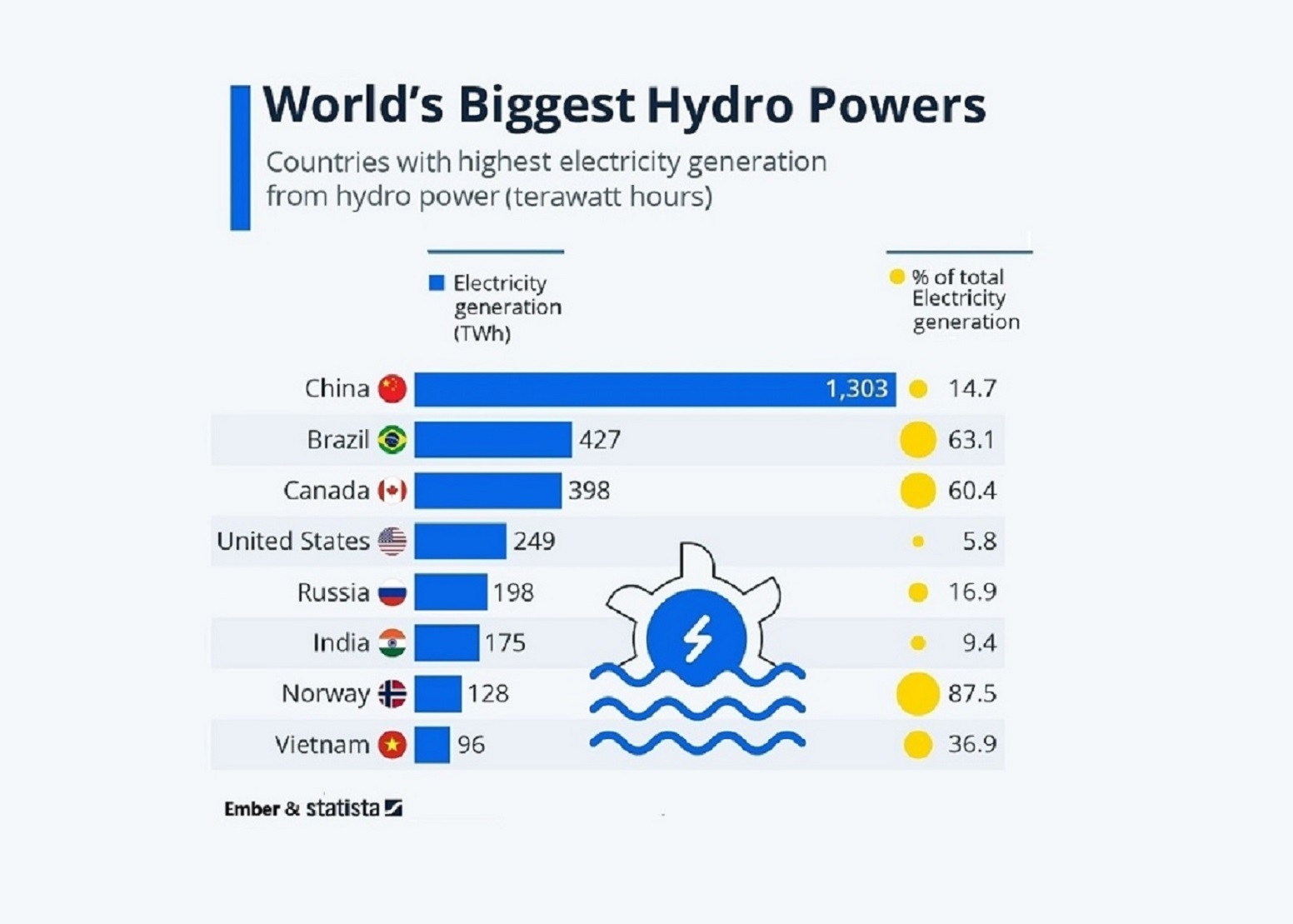
Pumped hydro storage (PHS) is a proven, efficient and scalable technology that is increasingly being used for storing excess, cheap energy generated from renewable energy sources such as wind and solar power.
What is pumped hydro?
It’s a type of energy storage technology that uses two water reservoirs, one at a higher elevation and one at a lower elevation, and a pump-turbine system. During periods of excess energy generation and low energy demand (lower price), water is pumped from the lower reservoir to the upper reservoir, where it is stored.
When the energy demand (and price) is high, the water is released from the upper reservoir and flows through the turbine, generating electricity. The process can be repeated by pumping water from the lower reservoir as needed. Pumped hydro storage is one of the most efficient and reliable energy storage technologies available, with an efficiency of up to 80%.

China rises to the global leader
China built its first pumped storage power station in 1968 — almost 90 years after the world’s first facility was built in Zurich, Switzerland. However, by the end of 2020 China had risen to the top globally in both operating and under-construction capacity.
China has built the largest pumped hydro energy storage facility in the world. The last of 12 generating units at the Fengning Pumped Storage Power Station, located in Hebei, commenced commercial operation on 31 December 2024 after being fully connected to the State Grid.
As of 2025 China has the largest pumped storage capacity in the world, with an aggregated installed capacity of 51 gigawatts (GW), surpassing all other countries. China aims to increase its cumulative installed capacity of pumped hydro energy storage in operation will reach 120 GW by 2030, and more than 400 GW by 2035.
These targets are set out in “The Mid- and Long-Term Development Planning for PSH (2021-2035)” document published by China’s National Energy Administration in 2021. That document has an accompanying list of 110 projects totalling 136 GW be taken forward.
China’s “PSH-plus” model sees planning for large renewable energy zones or corridors being matched with the development of PSH capacity. By bringing these resources together in tandem, particularly where they are placed in geographical proximity, renewable generation can be used more effectively and China’s vast common grid infrastructure maintained more efficiently.
The International Hydropower Association has recognized that:
“Through a clear planning process and suitable reward for investment, China has put in place a complete system for bringing forward the PSH capacity it has determined is necessary. As such it has established itself as the leader in deploying PSH and is set to stay ahead of the rest for the foreseeable future.”
Sources:
Seetao, June 14, 2026. https://www.seetaoe.com/details/268120.html
China Daily, May 23, 2025. https://global.chinadaily.com.cn/a/202505/23/WS682fc8efa310a04af22c111c.html
International Center for Science & Technology Innovation, December 31, 2024. https://en.ncsti.gov.cn/Latest/news/202501/t20250103_191671.html
Hydropower.Org, October 14, 2024. https://www.hydropower.org/blog/pumped-storage-hydropower-series-chinas-psh-plus-model
