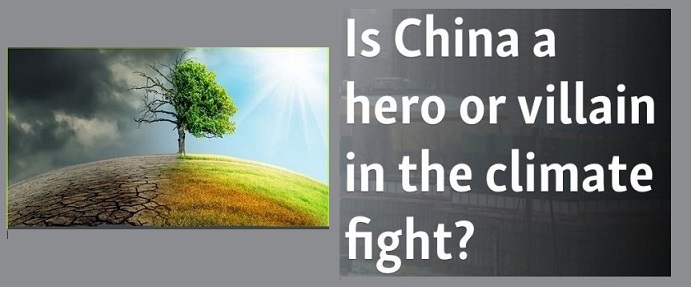
The Western media’s continued focus on China as “the world’s worst polluter” is devious and dishonest. Use of this phrase seems almost mandatory whenever China and climate change are discussed in Western media.
Out of context comments are used by the mainstream media oligarchies to promote the false perception that China is not vigorously combating climate change. The purpose of this article is to look at the facts.
China is of course the world’s most populous nation. This is very convenient for Western anti-China rhetoric, as it makes it easy to setup a “straw-man” comparison to the United States of America or the European Union states. It also assists the West in its ongoing xenophobic psychological warfare against China.
The way in which data is aggregated, or in this case, disaggregated, has a huge influence on perception and the capacity to demonise China and its government.
However, if we aggregate the same data in a slightly different way, the underlying data is not altered, but the “obvious” conclusions suddenly appear as less “objective” and politically motivated.
For the purpose of comparison we consider “the Western” industrialised countries as a geographic bloc – the USA, Japan, South Korea, the UK, Canada, Australia and Europe (all of Europe, not simply the EU).
Taking China and these 7 industrialised geographic entities allows for a realistic comparison between the two. These 8 entities produce 69% of the world’s annual CO2 emissions.
In the data below in respect to contributions of carbon emissions responsible for climate change, we look at the industialised economies as a geopolitical bloc, and compare it with China. For our comparison the huge Chinese economy stands alone, and the industrialised “West” aggregation allows comparison of CO2 emissions from two blocs of largely equivalent sized populations.
When this is done, the basis of a very different narrative emerges.
COMPARISON: CHINA vs THE WEST
Key points concealed by comparing China the most populous nations in the West – whether this be the USA, individual European nations or the EU as a whole, include:
- China and the Western industrialised countries each account for about 18% of total world population. The difference in population between China and the Western nations is less than 1%.
- Between them, China and the Western countries make up 38% of the world’s population and produce 69% of global annual CO2 emissions.
- China’s annual CO2 emissions are 13% (3.1 billion tonnes) less than the West’s annual emissions.
- China’s per capital CO2 emissions (6.86 tonnes) are about half of those of the West’s average of 12.1 tonnes, and only 41-44% those of Canada (15.59 t), USA (16.16 t) and Australia (16.88 t).
- China’s cumulative CO2 emissions (220 Bt) are only 19% of world cumulative emissions, while the West is responsible for at least three quarters of global cumulative CO2 emissions.
- China’s net share of CO2 emissions embedded in international trade is negative (-10%). Whenever a good is imported we need to include all CO2 emissions that were emitted in the production of that good, and vice versa to subtract all CO2 emissions that were emitted in the production of goods that were exported. In China’s case, this means that 10% of its annual CO2 production needs to be deducted and credited to the importing country where the products are consumed (USA, Europe, etc).
DATA BREAKDOWN
Population (billions)
- China = 1.444 (18.36 % of world population)
- West = 1.390 (17.67 % of world population)
- China + West = 2.980 (38 % of world population)World = 7.865
Annual CO2 emissions (billion tonnes – Bt)
- China = 10.7
- West = 13.8
- China + West = 23.98 Bt (69% of total world emissions)
Per capital CO2 emissions (tonnes)
- China = 6.86
- USA = 16.16
- Europe = 7.54
- Japan = 9.31
- S Korea = 12.15
- UK = 5.82
- Australia =16.88
- Canada = 15.59
Cumulative CO2 emissions (Bt) in 2019
- China = 220 (14% of world total cumulative emissions)
- West = 1146 (74% of world total cumulative emissions)
- China + West = 1366 Bt (87% of world total cumulative emissions
Share of CO2 emissions embedded in trade
- China = – 10.01 %
- USA = + 6.31 %
- Japan = +15.56 %
- S Korea = + 8.36 %
- U K = +42.1 %
- France = +33.21 %
- Australia = – 8.9 %
- Germany = +14.06 %
- Italy = +33.84 %
- Canada = + 0.31 %
REFERENCES
Carbon emission data used is from the Our World in Data website: https://ourworldindata.org/co2-emissions
Population data is taken from the Worldometer website: https://www.worldometers.info/world-population/population-by-country/
First published by China Environment Net on VK, May 12, 2021. https://vk.com/@chinaenvironment-climate-change-facts-comparing-china-with-the-west
GRAPHS


___________________________________________________________China Environment Net on VK, May 12, 2021. https://vk.com/@chinaenvironment-climate-change-facts-comparing-china-with-the-west
The author, Dr Paul Rutherford is editor of China Environment News Net. He has a PhD in ecological studies and environmental regulation from the Australian National University, as well as a Bachelor in Science Studies and Masters studies in social theory and philosophy. He has over 35 years experience in environmental policy, legislation and regulatory practice; he is a qualified environmental auditor and an experienced investigator and prosecutor. He has worked on a wide range of environmental, conservation and natural resource matters with government agencies, environmental regulators, environmental NGOs, university research and teaching, and private consulting.
