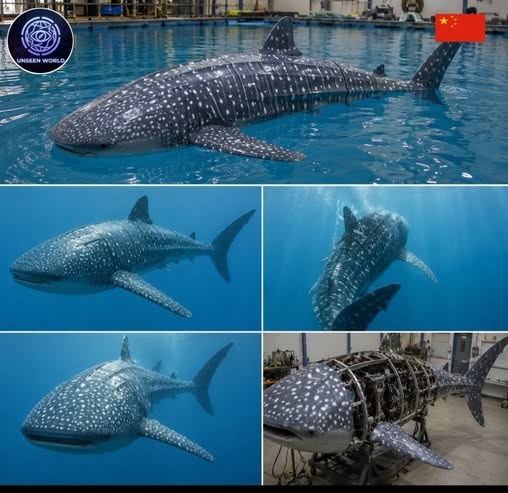
Researchers at the State-owned China Aerospace Science and Industry Corp have developed and made the world’s first robot whale shark.
The real whale shark is a slow-moving carpet shark and the largest known living fish.
The Chinese researchers have built multiple kinds of robot fish – the robotic whale shark is the largest mechanical fish made so far. The biomimetic machines are made of sensors, multi-joint fins, batteries and omnidirectional obstacle-avoidance systems.
The robotic whale shark closely mimics the appearance and movements of its real-life counterpart, demonstrating China’s remarkable progress in marine robotics and biomimetic engineering.
Designed to swim, dive, turn, and glide through the water with lifelike motions, the robotic creature showcases how advanced technology can replicate the behavior of some of the ocean’s largest animals.
The robotic whale shark is equipped with sophisticated propulsion systems, sensors, and control technologies that allow it to move smoothly through aquatic environments. By imitating the natural swimming patterns of a whale shark, engineers have created a machine capable of operating efficiently underwater while providing valuable opportunities for research, education, and technological development.
Such robotic marine animals can serve multiple purposes, including ocean exploration, environmental monitoring, underwater inspections, and public exhibitions. Their realistic movements help researchers study marine locomotion while advancing the design of future underwater vehicles that can navigate complex ocean environments with greater efficiency and agility.
This achievement highlights the growing capabilities of marine robotics and the potential for bio-inspired engineering to solve real-world challenges. By combining artificial intelligence, advanced materials, and innovative mechanical design, China’s robotic whale shark demonstrates how technology can draw inspiration from nature to create sophisticated machines. The project represents an exciting step forward in the evolution of underwater robotics and the exploration of the world’s oceans.
Sources:
China Daily, 2022. https://global.chinadaily.com.cn/…/WS620ef63da310cdd39b…
Unseen World, June 4, 2026. https://www.facebook.com/…/pfbid0f49gZg3QoS8zHB2sQ6MKpH…
