The site reveals a settlement where water was not simply managed for survival, but deliberately controlled, distributed, and integrated into the broader urban layout in ways that suggest long-term planning.
Archaeologists have uncovered a 4,000-year-old artificial water channel system in a site in Dengfeng, Henan Province in central China, offering fresh insight into early urban design and governance during the Xia Dynasty, widely seen as China’s earliest known dynasty. Researchers say the remains show a well-organized settlement with advanced engineering for its time, with a network of ditches, moat, and drainage channels shows advanced planning, large-scale labor, and early state-level organization.
Large-scale system shows planned design
Excavations revealed two main artificial ditches from the early Xia period. Each ditch is about three meters wide and stretches for more than 120 meters. Both run along a north-south direction and connect to a larger moat measuring around 10 meters across.
Together, these features formed a coordinated system for water supply, drainage, and spatial organization within the settlement. The layout suggests the system was designed as part of a broader urban plan rather than built in stages.
Ma Long, the archaeologist leading the excavation, said the ditches share the same structure and alignment. He noted that this reflects a consistent design approach and strong technical control. Building the system required removing thousands of cubic meters of earth, indicating organized labor on a large scale.
Network supported daily life and industry
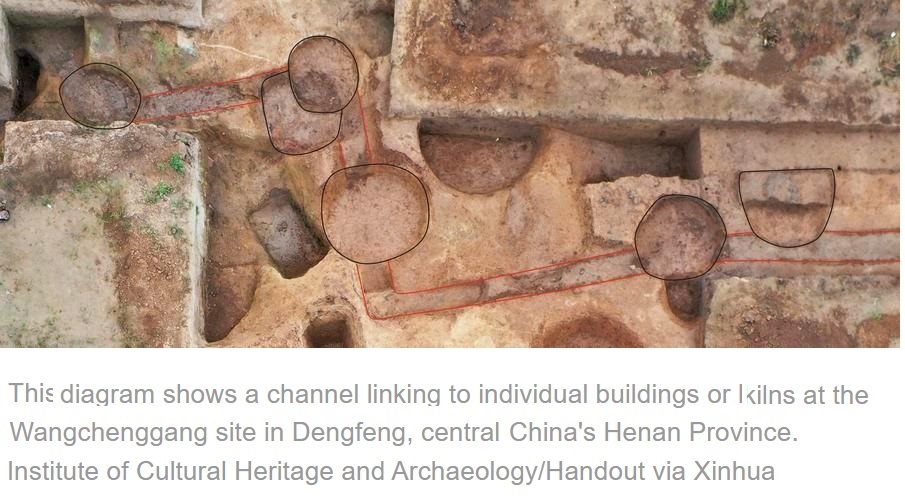
Researchers also uncovered several smaller channels linked to the main system. These channels range from 0.3 to one meter in width and were connected to buildings and kilns across the site.
The network allowed rainwater and wastewater to drain quickly, helping maintain dry living and working conditions. The system likely supported multiple needs, including water management, craft production, and settlement planning.
Archaeologists say this level of integration shows that people at the site had a clear understanding of how to control water and adapt their environment.
Evidence of early state organization
Experts say the scale and structure of the system point to centralized planning and management. Such projects would have required coordination, labor control, and technical knowledge.
Yang Wensheng, vice director of the Henan Provincial Institute of Cultural Heritage and Archaeology, said the findings provide strong evidence of standardized construction practices. He explained that the system reflects a unified authority capable of organizing large infrastructure projects.
The Xia Dynasty, dated from about 2070 BC to 1600 BC, has long been studied through historical records, but physical evidence remains limited. Discoveries like the Wangchenggang system help bridge that gap by offering direct proof of early urban development.
Ongoing research continues
The findings were presented at a forum highlighting recent archaeological work in Henan. Researchers say the Wangchenggang site remains key to understanding the origins of organized settlements in ancient China.
Excavation and analysis are still underway, with more results expected to further clarify how early societies planned and managed their cities.
Sources:
Greek Reporter, Apr 10, 2026. https://greekreporter.com/2026/04/10/water-system-china/
China Daily, Apr 10, 2026. https://global.chinadaily.com.cn/…/WS69d85b93a310d6866e…
