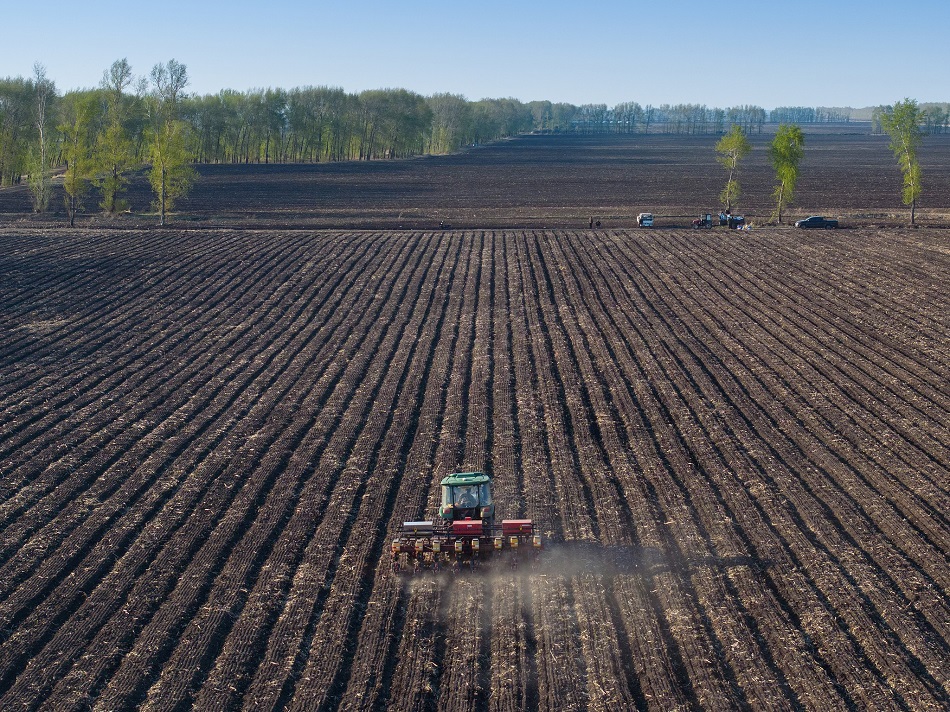
Black soil, considered the world’s most fertile for crops, once faced serious degradation in China – which hosts one of the world’s three largest black earth regions. During the 14th Five-Year Plan (2021–2025) period, over 400 million mu (26.67 million hectares) of black soil in China was restored, through no-till farming, straw return, and protective cultivation. Through these practices, the country has turned its farmland green and secured the future of its food supply.
China’s Black Soil Region is one of the world’s three largest black earth regions, primarily concentrated in the northeast plain. The unique climatic and hydrological conditions, coupled with the region’s vegetation, form the foundation for human accumulation, resulting in a deep and fertile layer of black soil. China’s Black Soil Region encompasses Heilongjiang, Jilin, Liaoning, and Inner Mongolia, where this expansive area covers 1.244 million square kilometers
Despite their relatively modest share in the global soil composition, black soils play a pivotal role, not just in supporting local communities but also in contributing to agricultural exports that nourish the global population. Remarkable yields are attributed to black soils, as evidenced by statistics indicating that over 50% of the global production of sunflower and small millet, 30% of wheat, 26% of soybean, and 16% of maize originate from black soils.
Recent research by University of Chinese Academy of Sciences has detailed the economic and ecological importance of conserving and managing these black soils.
The research points out that China’s black soils are renowned for their natural fertility, hold pivotal significance in global food production and play a crucial role in mitigating and adapting to climate change due to their excellent capacity for organic carbon sequestration.
However, black soils worldwide are subject to moderate to severe erosion due to the land use change, overuse of agrochemicals and high-intensity ploughing. Nearly 50% of organic carbon sequestration has been lost, resulting in nutrient imbalances, acidification, and biodiversity loss in black soil areas, severely compromising the capacity of food production and environmental sustainability.
China has ambitiously taken strides in the conservation and utilization of black soils, enacting its first law to protect black these invaluable resources, which have been promising. The research by the Chinese Academy of Sciences aimed to clarify the effect of China’s black soil conservation policies and projects on national grain supply security and greenhouse gas (GHG) emissions.
The research measures the contributions of grain production and GHG emissions in the black soil region in northeast China. Further, it analyzes the spatial and temporal characteristics of counties in advantage of grain production and GHG emissions from grain cultivation.
Through econometric analysis, this research evaluates the effectiveness of the pilot implementation of black soil conservation policies. Furthermore, it investigates the impacts of a comprehensive promotion of these policies, including optimization of grain structures, conservation tillage, organic soil cover, and nutrient management, on the future stabilization of national grain supply and the reduction of agricultural GHG emissions. The study results provide valuable information for Chinese agriculture as well as for global collaboration on black soil conservation and enhancement of agricultural land system management.
Sources:
CGTN, Nov 12, 2025. https://www.sciencedirect.com/science/article/abs/pii/S0195925524000696
Environmental Impact Assessment Review, Volume 106, May 2024. https://www.sciencedirect.com/science/article/abs/pii/S0195925524000696

 China Environment News