November 1, 2025
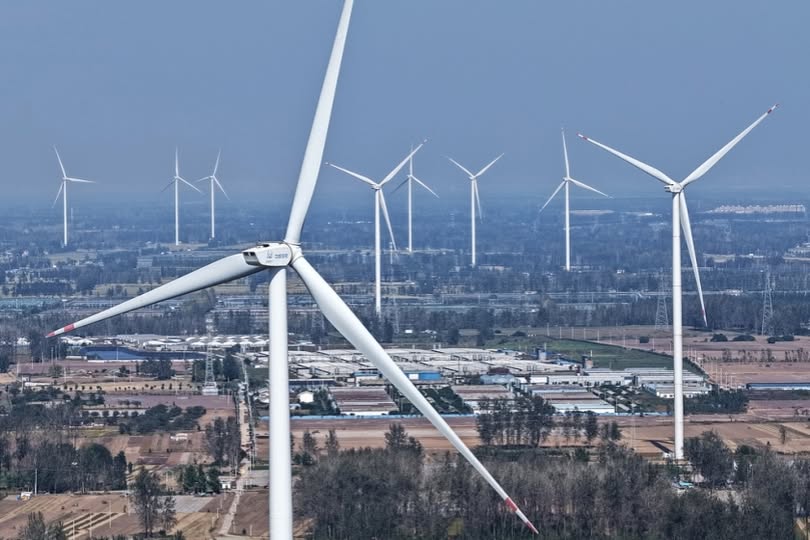
China has unveiled a new five-year plan aimed at accelerating its low-carbon transition, pledging to further expand the share of renewables and phase out fossil fuels in an orderly way.
Caixin Global, the Chinese daily, reports that the 15th Five-Year Plan, covering the period from 2026 to 2030 and released this week, sets a clear tone for the country’s energy policy by calling for the construction of a “new-type power system” that is clean, low-carbon, safe and efficient. The plan aims to ensure China’s carbon emissions peak as scheduled by 2030.
China’s 15th Five-Year Plan symbolizes a shift away from the traditional industrialization model and toward a technology-focused “new development paradigm.” As Xi Jinping emphasized, the plan prioritizes development by adapting “high-quality productive forces, innovative sectors such as artificial intelligence, biotechnology, and green energy” to local conditions.
China Daily noted that “the 15th Five-Year Plan prioritizes high-quality development — emphasizing breakthroughs in artificial intelligence, green energy, advanced manufacturing, and digital infrastructure. It seeks to balance economic modernization with environmental protection, ensuring that China continues to lead the world in renewable energy deployment and low-carbon innovation.”
“A central feature of the plan,” said China Daily, “is technological self-reliance, with China accelerating research in frontier fields such as quantum computing, semiconductors, biotechnology and space exploration. This vision not only reinforces China’s global competitiveness, but also ensures long-term stability and resilience in the face of evolving international dynamics.”
Development has always been the theme of China’s five-year plans — an enduring pursuit that unites ambition with action, and continuity with change.
China’s five-year plans have always been all about action, not slogans. Each five-year plan is not merely drafted, but acted upon, refined through practice, and carried forward with determination. Project-based management provides the backbone of execution, translating grand strategies into tangible results. Each plan builds upon the last, ensuring progress that is cumulative rather than episodic. Crucially, plan implementation in China is dynamic and adaptive.
This continuity reflects China’s distinctive balance between tradition and innovation. While revitalizing traditional sectors such as steel, textiles, and manufacturing through smart and green upgrades, China is simultaneously advancing frontier industries — artificial intelligence, quantum technology, and renewable energy — to forge new engines of growth.
Sources:
- China Daily, Oct 27, 2025. https://www.chinadaily.com.cn/…/WS68fedf23a310f735438b7…
- China Daily, Nov 1, 2025. https://www.chinadaily.com.cn/…/WS690572d2a310f215074b8…

 China Environment News