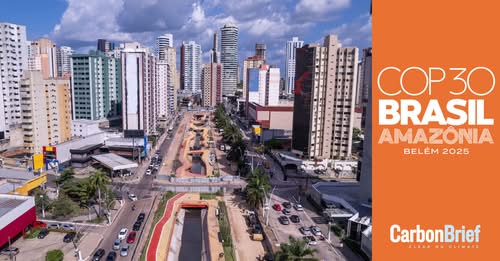
November 8, 2025
Key BRICS member Brasil, the president and host of the UN Climate Conference COP30 now underway, has published a “Baku to Belém roadmap” on how climate finance could be scaled up climate mitigation finance to “at least $1.3trillion” a year by 2035.
The idea for the roadmap was a late addition to the outcome of COP29 last year, following disappointment over the formal $300bn-per-year climate-finance goal agreed in Baku.
The new document, published ahead of the UN climate talks in Belém, Brazil, says it is not designed to create new financing schemes or mechanisms. Rather, the roadmap provides a “coherent reference framework on existing initiatives, concepts and leverage points to facilitate all actors coming together to scale up climate finance in the short to medium term”.
It details suggested actions across grants, concessional finance, private finance, climate portfolios, capital flows and more, designed to drive up climate finance over the next decade.
Despite geopolitical uncertainty, there is hope that this roadmap can lay out a pathway to the “trillions” in climate finance that developing countries say they need to meet their climate targets.
Countries have divergent views on how to get there, but some notable trends have emerged from the roadmap, which was spearheaded by the Azerbaijani and Brazilian COP presidencies.
Carbon Brief has published details what the Baku to Belém roadmap is, why it was launched and what the key points within it are.
- Why was the ‘Baku to Belém roadmap’ launched?
- What is the goal of the roadmap?
- What are different countries’ views on climate finance?
- What are the solutions that the roadmap has identified?
- What happens next?
See the Carbon Brief summary at:
https://www.carbonbrief.org/cop30-what-does-the-baku-to…/
Source: Carbon Brief, Nov 5, 2025.

 China Environment News