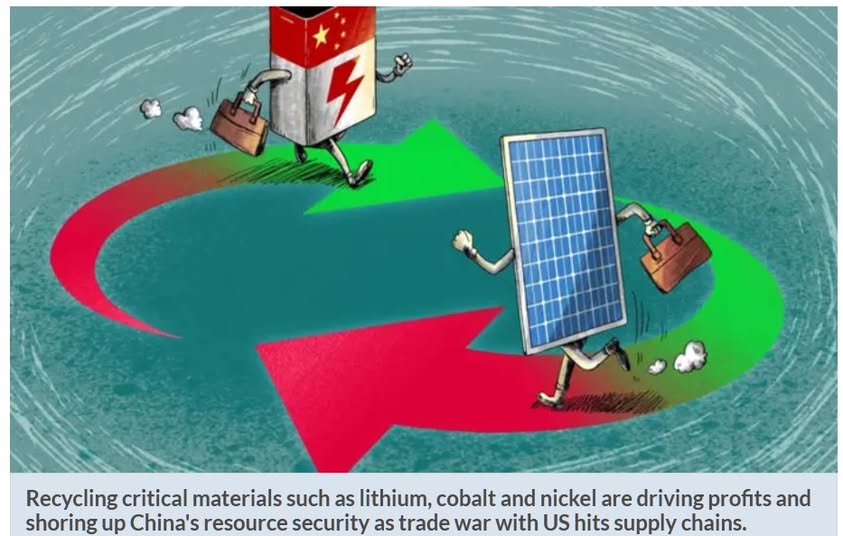
Costly components such as lithium along with other materials such as cobalt and nickel, hold their value beyond the life of the batteries powering China’s massive electric-vehicle (EV) industry.
“There is huge potential in the business of new-energy waste, because new energy is where China and the world are going,” said the sales manager at a subsidiary of Henan Hairui Intelligent Technology in Zhengzhou, Henan province.
Speaking at a recent trade fair for environmental technologies in Shanghai, the owner said 70% of his company’s business is dedicated to machines for recycling batteries and solar panels.
China relies heavily on imports for many key minerals, especially those for new-energy and high-end manufacturing, such as cobalt, nickel and lithium. As more and more batteries and solar panels reach the end of their life cycle in China – a global leader in renewable-energy deployment – Chinese businesses are embracing a circular economy, where materials are reused and reintroduced into new products, reducing waste and conserving resources.
With valuable metals comprising essential components in many of today’s fast-growing, clean-energy technologies, the cycle is especially meaningful in terms of improving China’s mineral independence as it navigates intensifying global trade tensions.
“The recycling of minerals is largely for the sake of resource security,” said Du Huanzheng, Professor of Environmental Economics who specialises in circular economy at Shanghai’s Tongji University.
“China is also seeking new economic growth by strengthening recycling efforts, which, in the past, were more driven by the need to solve pollution issues,” he said.
The large-scale equipment upgrades and trade-in of consumer goods, two initiatives launched a year ago to boost domestic demand in a slowing economy, have pushed up demand for recycling and represent the potential for a new round of economic growth.
In response to that rising demand, a new state-owned giant was created directly under the State Council last year. The China Resources Recycling Group aims to build an offline resource recycling network covering waste ranging from durable consumer goods, such as electronic products, to retired wind power and photovoltaic equipment, according to an official announcement in October.
After about a decade of rapid growth in the use of EVs, whose battery life is set at an upper limit of eight years, China has already started seeing the “large-scale retirement of car batteries”, according to the State Council.
Unlike fossil fuels, which are gone once burned, the metals in these new-energy products can be recycled, and this is of critical importance amid a worsening trade war between China and the United States.
Source: [Extract] The Star, May 6, 2025. https://www.thestar.com.my/…/chinas-dying-ev-batteries…

 China Environment News