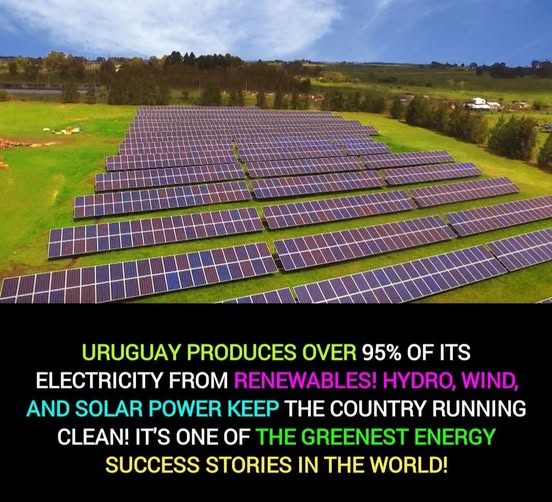
Uruguay stands out as a global leader in renewable energy, with an impressive 99% of electricity coming from renewable sources.
On March 1, 2025 Yamandu Orsi took office as Uruguay’s new president. Orsi, of the left-wing Broad Front coalition, now presides over one of South America’s most economically and politically stable countries.
With a population of 3.51 million, and an area of approximately 176,000 square kilometers, Uruguay is geographically the second-smallest nation in South America, after Suriname. Its economy is forecast to expand by 3% this year, above the regional average, and the government wants to attract investment to maintain growth.
In August 2018 Uruguay formally joined the Belt and Road Initiative, although China has been Uruguay’s top trading partner since 2004. Uruguay’s second largest trading partner is its neighbour, and BRICS member, Brazil which as the chair of the BRICS bloc in 2025 has invited Uruguay to attend the BRICS meeting in July.
Uruguay stands out as a global leader in renewable energy, with an impressive with 99% of power coming from renewable sources, and in February the country achieved 100% electrification nationwide.
This remarkable achievement is the result of a rapid transition that began in the early 2000s, shifting from heavy reliance on fossil fuels to a diverse mix of hydropower, wind, biomass, and solar energy.
The new government, according to media reports, is considering options for the second phase of the nation’s energy transition, including meeting increasing demand from electrification of transportation and clean fuel production. The energy sector is a priority, with a focus on solar capacity.
Uruguay will be under a lot of pressure from the US to limit Chinese investment in strategic sectors like infrastructure and telecommunications, following the Trump regime’s “gunboat diplomacy” which forced Panama out of the Belt and Road Initiative.
Nevertheless, there is strong bipartisan support from both the new government and its precedessor on strenthening trade with China. The new government has highlighted the past administration’s work with the BRICS+ bloc and continues to examine the possibility of Uruguay joining the BRICS+ New Development Bank (NDB). The incorporation of Uruguay was approved by the NDB in 2021, although it was never formalized due to a lack of compliance with some procedures.
Sources:
- Argus Media, Mar 1, 2025. https://www.argusmedia.com/…/2663197-energy-a-priority…
- Buenos Aries Herald, Mar 29, 2025. https://buenosairesherald.com/…/uruguays-orsi-will-look…
- Agribusiness Global, February 2025, https://www.agribusinessglobal.com/…/china-in-latin…/

 China Environment News