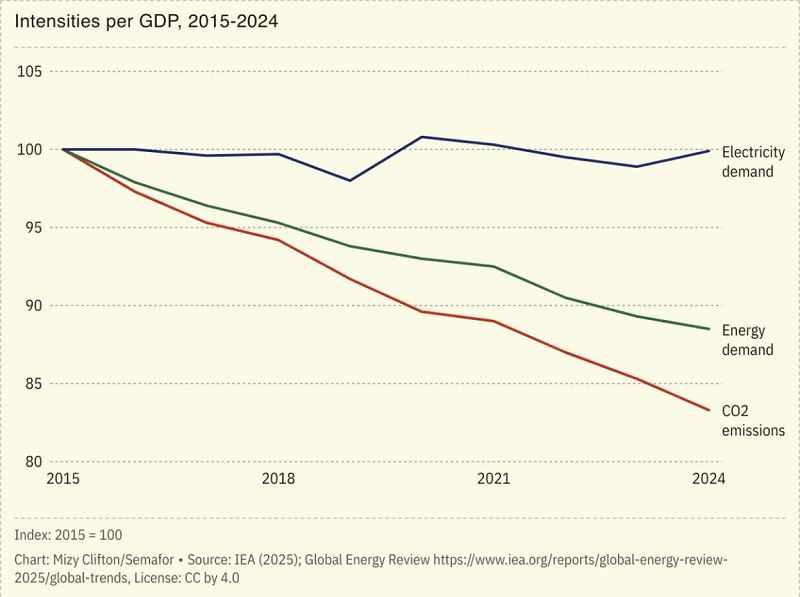
Renewable energy accounted for 81.1% of all new global electricity, as global consumption surged by 4.3% in 2024, nearly double the annual average growth rate over the past decade and almost twice as fast as wider energy demand, according to the International Energy Agency.
China as the engine of the world’s economy, accounted for more than half of the rise. However, demand also reached a new high in the advanced economies amid structural shifts including heatwaves resulting in growing access to electricity-intensive cooling appliances, data center expansion, and a pickup in industrial production.
However, for the first time ever, power generation from renewables and nuclear covered two-fifths of total global generation.
New renewable energy capacity installed worldwide set a new annual record for the 22nd consecutive year, with the continued rapid adoption of clean technologies “increasingly loosening the link between economic growth and and emissions,” the International Energy Agency’s Executive Director Fatih Birol said.
In 2024, 80% of the growth in global electricity generation was provided by renewable sources and nuclear power. Together, they contributed 40% of total generation for the first time, with renewables alone supplying 32%. New renewables installations hit record levels for the 22nd consecutive year, with around 700 GW of total renewable capacity added in 2024, nearly 80% of which was solar PV. In the United States, solar PV and wind’s share rose to 16%, overtaking that of coal. In China, solar PV and wind reached nearly 20% of total generation.
In 2024, over 7 GW of nuclear power capacity was brought online, 33% more than in 2023. The new capacity added was the fifth-highest level in the past three decades. Electricity generation from nuclear in 2024 rose by 100 TWh, equalling the largest increase this century outside of the post-Covid rebound. Construction starts for nuclear power plants grew by 50% in 2024, exclusively using Chinese and Russian designs.
Source: IEA Global Energy Review 2025, https://www.iea.org/reports/global-energy-review-2025

 China Environment News