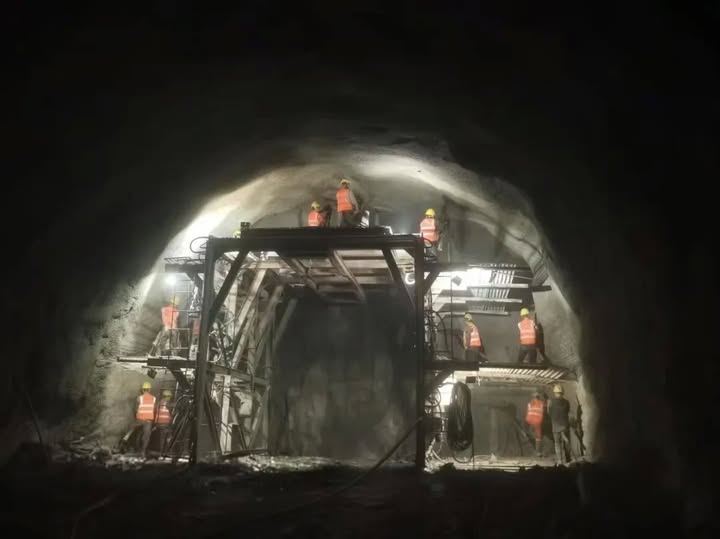
A Chinese state-led consortium is developing a 300 MW/1200 MWh compressed air energy storage (CAES) project in Xinyang, Henan province, featuring an entirely artificial underground cavern—China’s first of its kind.
The project consortium is reported by PV Magazine to lead by local state-owned enterprise Xinyang Construction Investment Group and CAES technology specialist China Energy Storage National Engineering Research Center and backed by two other state investment firms.
The project is set to be completion by the end of 2026.
How Does CAES Work?
Compressed air energy storage (CAES) technology stores energy by compressing air to high pressure in a storage reservoir, typically a large underground cavern, where it can be stored for long periods until needed.
Excess energy generated from renewable energy sources when demand (and prices) are low can be stored with this technology. When the electricity demand is high, the compressed air is released and passes through a turbine that generates electricity.
The process of compressing air generates heat, which is normally wasted. However, in a CAES system, the heat generated during compression is captured and stored in thermal energy storage systems. This stored heat can be used to preheat the compressed air before it enters the turbine, making the process more efficient.
This is a pilot project under China’s National Energy Administration’s new energy storage initiative. As the energy input is largely unused, ie surplus, renewable energy, the system is sustainable and has significant environmental and economic benefits. A key point to recognize is China’s willingness to investigate and develop a wide range of low carbon energy options
As to the energy efficiency of the project, the cited article linked below from ESS News, says:
“Once operational, the facility is expected to achieve a conversion efficiency of 72.1% and generate 420 million kWh annually—enough to power 350,000 households. The system incorporates China Energy Storage’s latest 300 MW CAES technology, featuring multi-stage compressors, high-load turbines, and advanced supercritical heat exchangers.”
“This design improves efficiency by 2% over its 100MW predecessor while reducing unit costs by 30%. By replacing conventional CAES combustion chambers with high-efficiency heat exchangers, the system eliminates reliance on fossil fuels, ensuring zero emissions and environmental sustainability.”
_________________________________________________________________
Sources:
PV Magazine, Feb 17, 2025. https://www.ess-news.com/2025/02/14/chinas-innovative-1-2-gwh-compressed-air-energy-storage-project/
Electricity Forum, accessed Feb 18, 2025. https://electricityforum.com/…/compressed-air-energy…

 China Environment News